“I want to move the world through advertising.”
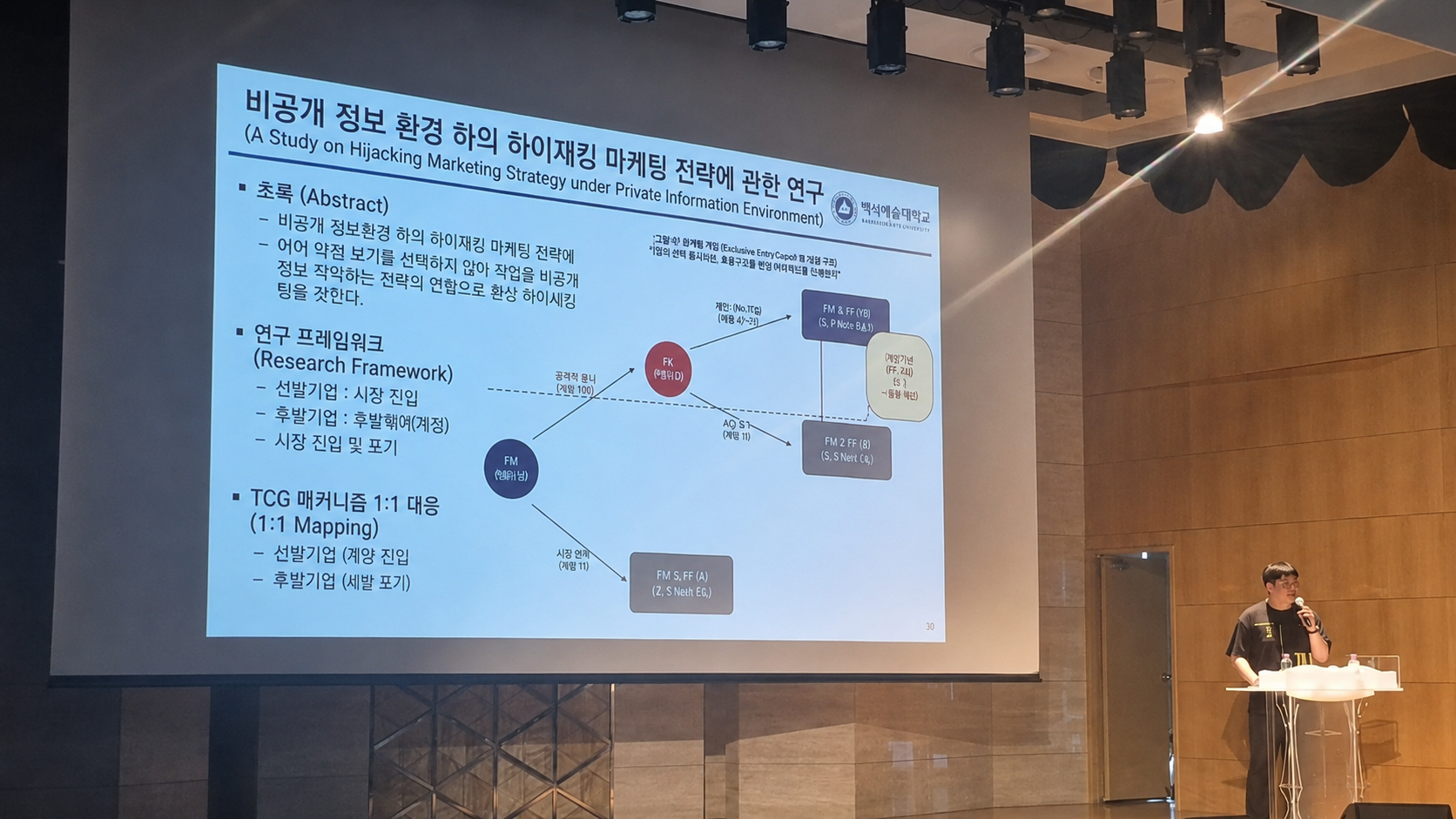
This is how Lee Seong-jae, a second-year student majoring in Advertising and Public Relations at Baekseok Arts University, introduces himself. Passionate about understanding how advertising and marketing influence consumer behavior, Lee recently conducted an interdisciplinary study titled A Study on Hijacking Marketing Strategies Under Non-Public Information Environments: Focusing on TCG Game Models.
While many researchers rely on economics or psychology to explain corporate competition and consumer behavior, Lee took a different path. His inspiration came from a long-time personal hobby: Trading Card Games (TCGs).
Popular games such as Yu-Gi-Oh!, Magic: The Gathering, and the Pokémon Trading Card Game are played in environments filled with hidden information. Players rarely know exactly what cards their opponents possess, forcing them to make decisions with limited resources, predict their opponents’ intentions, and respond at precisely the right moment.
To Lee, this structure closely resembles the dynamics of modern marketing competition.
“Even when a market-leading company invests enormous amounts of capital to establish a new market, hidden information still exists in the form of consumer needs, preferences, and fatigue. Just as players can turn the tide of a game by exploiting an opponent’s strategy, I believed that marketers could leverage the traffic and attention created by market leaders through hijacking strategies.”
Motivated by this idea, Lee sought to develop a theoretical framework that could explain how challenger brands gain competitive advantages by utilizing market conditions established by first movers. To do so, he analyzed game mechanics such as chain systems and strategic counterplay, exploring how these concepts could be applied to real-world marketing environments.
The research process itself proved to be a memorable journey. What began as curiosity about connecting a favorite hobby with academic research gradually evolved into a much deeper investigation. By examining game rule structures, studying global TCG industry data, and comparing them with real-world corporate competition, Lee discovered connections far beyond what he had initially expected.
Asked about the most memorable moment of his research, Lee points to the moment he realized he had found a “marketing battlefield” hidden within card games.
“At first, I simply wanted to write a paper using a topic I enjoyed. But as the research progressed, I realized that the strategic structures found in these games corresponded remarkably well with actual corporate competition. That realization was incredibly exciting.”
His study explores similarities between TCG mechanics and real-world business strategies through examples such as Coca-Cola and Pepsi, as well as competition among major digital platform companies. In addition, he conducted a consumer survey to examine the relationship between information asymmetry and brand-switching behavior, connecting theoretical discussions with empirical observations.
What makes the research particularly noteworthy is that it does not view games merely as entertainment or cultural products. Instead, Lee interprets TCGs as systems of strategic decision-making and attempts to extend the competitive structures embedded within them into the fields of business and marketing research.
Today, Lee’s greatest academic interest remains the study of marketing strategies that influence consumer behavior. While psychology seeks to understand the human mind, he believes marketing goes one step further by identifying specific consumer needs and transforming them into real-world value.
His future ambitions are equally clear.
“I want to become more than someone who creates advertisements. I want to be a strategist who understands market dynamics and designs the most effective strategies possible, even with limited resources.”
Lee emphasizes the importance of data-driven decision-making over intuition or luck. In particular, he hopes to develop expertise in hijacking marketing strategies—approaches that identify opportunities within markets already shaped by dominant players and create new competitive advantages through carefully timed interventions.
Ultimately, his research represents more than a comparison between card games and marketing. It demonstrates how personal interests and hobbies can evolve into meaningful academic questions, leading to original perspectives and innovative research.
Finally, Lee offered a message to fellow student researchers.
“I do not believe academic achievement is determined by the name of your school or the environment around you. It comes from the persistence to prove your own ideas and the courage to pursue questions that genuinely interest you.”
What began as curiosity inspired by a single card game eventually became an academic research project. In turn, that research opened a new way of understanding corporate competition and consumer behavior. Lee Seong-jae’s journey reminds us that meaningful academic insights can emerge from the most unexpected places—even from a deck of cards.